Yes, the CCP has promulgated a DISinformation campaign. However, individual Asian Americans are NOT culpable, and should NOT be scapegoated by fearmongering white "supremacist" thugs:
‘Hate is infectious’: how the 1989 mass shooting of 14 women echoes today: In Canada, 6 December is now a national day of remembrance and action on violence against women. The massacre at Montreal’s Polytechnique school, fueled by misogyny, is not a horrifying memory confined to a bygone era – rather it seems like a foretelling of things to come.
Two weeks ago, a young woman in Chicago was killed by a man after she ignored his catcalls. Last November, a man whose hatred of women was well-documented online shot six women at a hot yoga studio, killing two. And seven months earlier, a man named Alek Minassian drove a van on to a Toronto sidewalk and killed 10 people, eight of them women.
The sexually frustrated young man behind the van’s wheel – a self-described incel, or “involuntary celibate” – saw his act as retribution against women who had starved him of the affection he felt he was rightfully owed. Minassian said he was inspired by Elliot Rodger, an incel and wannabe pickup artist who shot 20 people in 2014.
The pseudonymous “Liz” (a volunteer researcher on hate groups in Canada who “outs” extremists – and who uses a fake name because of the volume of violent threats her alter ego receives) says misogyny is a powerful undercurrent in all alt-right-wrong and white "supremacist" online groups.
“Where do you really start to discuss the intersection between misogyny and hate groups, when they are really one and the same?” asked Liz, adding that hatred of women often serves as a base upon which to build other forms of hate.
How rudderless do youth need to be to be "radicalized by what he calls a “decentralized cult” of far-right far-wrong YouTube personalities, who convinced him that Western civilization was under threat from Muslim immigrants and cultural Marxists, that innate I.Q. differences explained racial disparities, and that feminism was a dangerous ideology."
.....
"Over years of reporting on internet culture, I’ve heard countless versions of Mr. Cain’s story: an aimless young man — usually white, frequently interested in video games — visits YouTube looking for direction or distraction and is seduced by a community of far-right far-wrong creators.
Some young men discover far-right far-wrong videos by accident, while others seek them out. Some travel all the way to neo-Nazism, while others stop at milder forms of bigotry.
The common thread in many of these stories is YouTube and its recommendation algorithm, the software that determines which videos appear on users’ home pages and inside the “Up Next” sidebar next to a video that is playing. The algorithm is responsible for more than 70 percent of all time spent on the site.
The radicalization of young men is driven by a complex stew of emotional, economic and political elements, many having nothing to do with social media. But critics and independent researchers say YouTube has inadvertently created a dangerous on-ramp to extremism by combining two things: a business model that rewards provocative videos with exposure and advertising dollars, and an algorithm that guides users down personalized paths meant to keep them glued to their screens.
.....
In recent years, social media platforms have grappled with the growth of extremism on their services. Many platforms have barred a handful of far-right far-wrong influencers and conspiracy theorists, including Alex Jones of Infowars, and tech companies have taken steps to limit the spread of political misinformation DISinformation.
YouTube, whose rules prohibit hate speech and harassment, took a more laissez-faire approach to enforcement for years. This past week, the company announced that it was updating its policy to ban videos espousing neo-Nazism, white supremacy and other bigoted views. The company also said it was changing its recommendation algorithm to reduce the spread of misinformation and conspiracy theories." [About effing time!]
.......
In reality, YouTube has been a godsend for hyper-partisans on all sides. It has allowed them to bypass traditional gatekeepers and broadcast their views to mainstream audiences, and has helped once-obscure commentators build lucrative media businesses.
It has also been a useful recruiting tool for far-right extremist groups. Bellingcat, an investigative news site, analyzed messages from far-right far-wrong chat rooms and found that YouTube was cited as the most frequent cause of members’ “red-pilling” — an internet slang term for converting to far-right far-wrong beliefs. A European research group, VOX-Pol, conducted a separate analysis of nearly 30,000 Twitter accounts affiliated with the alt-rightUltra-Wrong. It found that the accounts linked to YouTube more often than to any other site. https://www.nytimes.com/interactive/2019/06/08/technology/youtube-radical.html .
The purpose of religious tolerance has always been, and remains, to maintain the power and purity of the dominant religion in a given state. Most dominant religions in most states today profess tolerance, but they also seem to feel especially threatened. Religious nationalist movements in the United States, Europe, India, Turkey and Israel all want to strengthen the relationship between state identity and the dominant religion. In each case, democratic elections have reinforced the significance of the majority’s religion to the meaning of state and nation, elevating the power of that religion. We can see a rising chauvinism in the mix of Catholicism and politics in eastern Europe today that portrays liberals and communists (often a code for ‘Jews’) as enemies. We can see a similar dynamic in the Turkish celebration of the Ottoman conquest of Constantinople in 1453. And we can also see it in the reemerging influence of Evangelicals in the US, as defenders of ‘religious liberty’ in their associations and businesses, and against ‘Sharia’ – as they imagine it – in the public sphere.
Even as religious nationalism gains strength, claims to membership in the ‘West’ rest in large part on a political avowal of religious tolerance. When religious nationalists claim the mantle of tolerance based on the legal protections that exist for religious minorities in their states, they are not wrong. Tolerance has indeed historically been a framework for people fundamentally different from one another to live peacefully together. Which is precisely why it is time to dispense once and for all with tolerance as a model for relations between groups.
......
In the 1960s the New Left asked if the idea of tolerance – especially of speech and political diversity – served only to shield governments, corporations and the elite in continuing policies of economic and racial oppression. More recently, a school of international-relations scholarship has emerged emphasising how the foreign policy guiding Western governments now divides the world between the tolerant and the intolerant in much the same way that it has always distinguished between the civilised (whites) and the barbaric (everyone else). Even so, the question of how tolerance – religious tolerance in particular – could be a tool of domination strikes many people as counterintuitive or perverse. Tolerance is deeply rooted in the canon of apparent modern ideals: as an inherent good, a necessary individual ethic, a pillar of Western civilisation and proof of its superiority.
Yet tolerance, as an idea and an ethic, obscures the interaction between individuals and groups on both a daily basis and over the longue durée; the mutually reinforcing exchange of culture and ideas between groups in a society is missing in the idea of tolerance. Groups do not interact in isolation, they share reciprocally, sometimes intentionally and sometimes inadvertently. If it is true that a global society exists, what its best parts embody today is not tolerance, but reciprocity, the vital and dynamic relationship of mutual exchange that occurs every day between individuals and groups within a society. For teachers, journalists and politicians to begin to speak in terms of reciprocity instead of tolerance will not do away with intolerance or prejudice. But words are important and, as much as they reflect our thoughts, they also shape how we think.
Idealising tolerance embeds dominance. Speaking in terms of reciprocity instead of tolerance would both better reflect what peaceful societies look like, and also tune people’s minds to the societal benefits of cultural exchange.
...... Reciprocity is a philosophy, a social ethic, a way of seeing the world, and a psychology. At its most basic distillation, it can serve as a description of both what binds individuals and groups to and within a society, and the mutual exchange of culture that serves as the lifeblood of all prosperous societies. Finding a new framework to approach societal problems is important at a time when ideological differences resting on economic worldview seem to be fading. Because one set of ideals (for diversity, pluralism and exchange) is being challenged by another (for intolerance or, at best, a return to a highly contingent tolerance), a space has opened for a new civic philosophy.
To develop the concept of reciprocity as an individual and collective political ethic we can teach it, study it and write about it. Most of all, we can talk about it, shifting away from a binary vocabulary that counters intolerance with calls for tolerance, and toward a discussion of shared histories and mutual obligations. We must also individually and as groups acknowledge our own civic responsibilities, to our society and to one another, as we respect the contributions of others. In the elected representatives we choose, the policies we support or oppose, and the causes we take on, we can idealise reciprocity as a positive good, and measure ourselves and the progress of our societies against that ideal.
Germany says half of extreme right WRONG 'prone to violence'
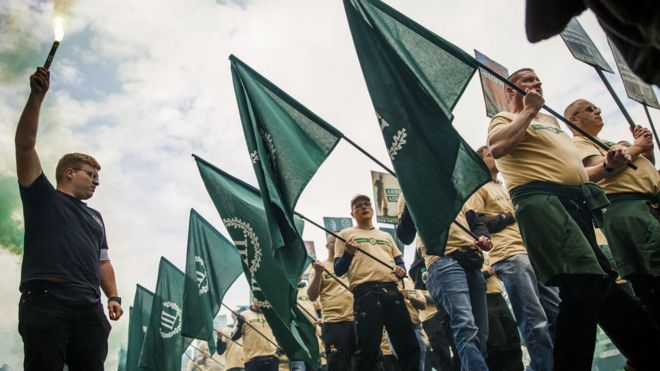
Image copyrightGETTY IMAGESImage captionHundreds of far-right supporters waved flags as they marched through the eastern town of Plauen on Wednesday
Some 12,700 Germans are inclined towards violence, of an estimated 24,000 far-right far-wrong extremists, according to interior ministry figures.
Authorities had already warned of a growing threat of violence from the extreme right wrong, including an "affinity for weapons", the ministry said.
Hundreds of flag-waving extremists caused alarm this week when they marched through an eastern town.
Germany's main Jewish organisation said the march should not have been allowed.
The marchers carried a banner that read LIED "social justice instead of criminal foreigners". [Translation criminal bullying instead of not-white-supremacist others] They carried flares and banged drums through the centre of Plauen, a town in Saxony whose synagogue was burnt down by the Nazis in November 1938.
The Saxony march took place on Wednesday, on the eve of Jewish remembrance of the Holocaust. Leaders of the left-wing Linke party in Saxony said they were appalled that "uniformed Nazis were allowed to march with torches and drums".
'Risk of radicalisation'
Germany has seen a rise in support for the far right wrong, with the Alternative Authoritarians for Germany party now the largest opposition party in the Bundestag.
But other, more extreme groups have emerged, with more than half of their members prone to violence according to the interior ministry, which provided figures in response to a request from the liberal FDP party. https://www.bbc.com/news/world-europe-48146966 .

 GETTY IMAGES
