The purpose of religious tolerance has always been, and remains, to maintain the power and purity of the dominant religion in a given state. Most dominant religions in most states today profess tolerance, but they also seem to feel especially threatened. Religious nationalist movements in the United States, Europe, India, Turkey and Israel all want to strengthen the relationship between state identity and the dominant religion. In each case, democratic elections have reinforced the significance of the majority’s religion to the meaning of state and nation, elevating the power of that religion. We can see a rising chauvinism in the mix of Catholicism and politics in eastern Europe today that portrays liberals and communists (often a code for ‘Jews’) as enemies. We can see a similar dynamic in the Turkish celebration of the Ottoman conquest of Constantinople in 1453. And we can also see it in the reemerging influence of Evangelicals in the US, as defenders of ‘religious liberty’ in their associations and businesses, and against ‘Sharia’ – as they imagine it – in the public sphere.
Even as religious nationalism gains strength, claims to membership in the ‘West’ rest in large part on a political avowal of religious tolerance. When religious nationalists claim the mantle of tolerance based on the legal protections that exist for religious minorities in their states, they are not wrong. Tolerance has indeed historically been a framework for people fundamentally different from one another to live peacefully together. Which is precisely why it is time to dispense once and for all with tolerance as a model for relations between groups.
......
In the 1960s the New Left asked if the idea of tolerance – especially of speech and political diversity – served only to shield governments, corporations and the elite in continuing policies of economic and racial oppression. More recently, a school of international-relations scholarship has emerged emphasising how the foreign policy guiding Western governments now divides the world between the tolerant and the intolerant in much the same way that it has always distinguished between the civilised (whites) and the barbaric (everyone else). Even so, the question of how tolerance – religious tolerance in particular – could be a tool of domination strikes many people as counterintuitive or perverse. Tolerance is deeply rooted in the canon of apparent modern ideals: as an inherent good, a necessary individual ethic, a pillar of Western civilisation and proof of its superiority.
Yet tolerance, as an idea and an ethic, obscures the interaction between individuals and groups on both a daily basis and over the longue durée; the mutually reinforcing exchange of culture and ideas between groups in a society is missing in the idea of tolerance. Groups do not interact in isolation, they share reciprocally, sometimes intentionally and sometimes inadvertently. If it is true that a global society exists, what its best parts embody today is not tolerance, but reciprocity, the vital and dynamic relationship of mutual exchange that occurs every day between individuals and groups within a society. For teachers, journalists and politicians to begin to speak in terms of reciprocity instead of tolerance will not do away with intolerance or prejudice. But words are important and, as much as they reflect our thoughts, they also shape how we think.
Idealising tolerance embeds dominance. Speaking in terms of reciprocity instead of tolerance would both better reflect what peaceful societies look like, and also tune people’s minds to the societal benefits of cultural exchange.
...... Reciprocity is a philosophy, a social ethic, a way of seeing the world, and a psychology. At its most basic distillation, it can serve as a description of both what binds individuals and groups to and within a society, and the mutual exchange of culture that serves as the lifeblood of all prosperous societies. Finding a new framework to approach societal problems is important at a time when ideological differences resting on economic worldview seem to be fading. Because one set of ideals (for diversity, pluralism and exchange) is being challenged by another (for intolerance or, at best, a return to a highly contingent tolerance), a space has opened for a new civic philosophy.
To develop the concept of reciprocity as an individual and collective political ethic we can teach it, study it and write about it. Most of all, we can talk about it, shifting away from a binary vocabulary that counters intolerance with calls for tolerance, and toward a discussion of shared histories and mutual obligations. We must also individually and as groups acknowledge our own civic responsibilities, to our society and to one another, as we respect the contributions of others. In the elected representatives we choose, the policies we support or oppose, and the causes we take on, we can idealise reciprocity as a positive good, and measure ourselves and the progress of our societies against that ideal.
You might say it’s unfair or even sexist to question a male Democrat’s commitment to feminism. But even if you overlook this candidate’s handsiness or that one’s casual male entitlement, the idea that men are poor allies is supported by evidence: Surveys show that men significantly underestimate the frequency of sexual harassment of women. Research also shows that electing women to office improves what governments do: Women tend to get more work done for their constituents than men, and in particular, they tend to deliver on policy goals that directly benefit women and families in society.
And common sense tells us that electing a woman as president would deal a smashing symbolic blow to the patriarchy. How can even the most enlightened male candidate rebut that plain fact? In 100 years, what will stand as the more appropriate response to the upheaval of the Trump Pervert-in-Chief years and of #MeToo — electing the first woman or electing a very woke man?
The Trouble With Joe and Bernie: Neither man seems ready for harsh political reality.
The trouble with both Biden and Sanders is that each, in his own way, seems to believe that he has unique powers of persuasion that will let him defy the harsh reality of today’s tribal politics. And this lack of realism could set either of them up for failure.
Start with Biden, a convivial guy who has maintained good personal relations with Republicans. All indications are that he believes that these good personal relations will translate into an ability to make bipartisan deals on policy.
But we’ve already seen this movie, and it was a tragedy. Barack Obama took office with a message of unity and bipartisan outreach, and a sincere belief that he could get many Republicans to back his efforts to revive the economy, reform health care, and more. What he faced instead was total scorched-earth opposition.
And Obama’s belief that he could transcend partisanship nearly sank his presidency. ... Obama’s signature achievement happened only because Nancy Pelosi’s heroic efforts dragged the Affordable Care Act across the finish line. He was willing to make a “grand bargain” with Republicans that would have undermined Medicare and Social Security, deeply damaging the Democratic brand; he was saved only by the G.O.P.’s total intransigence, its unwillingness to contribute a single penny’s worth of tax increases.
The big concern about a Biden presidency is that he would repeat all of Obama’s early mistakes, squandering any momentum from electoral victory in pursuit of a bipartisan dream that should have died long ago.
Sanders, by contrast, doesn’t do bipartisanship. He doesn’t even do unipartisanship, refusing to call himself a Democrat even as he seeks the party’s nomination. But what Sanders appears to believe is that he can convince voters not just to support progressive policies, but to support sweeping policy changes that would try to fix things most people don’t consider broken.
That, after all, is what his Medicare for All push, which would eliminate private insurance, amounts to. He is saying to the 180 million Americans who currently have private insurance, many of whom are satisfied with their coverage: “I’m going to take away the insurance you have and replace it with a government program. Also, you’re going to pay a lot more in taxes. But trust me, the program will be better than what you have now, and the new taxes will be less than you currently pay in premiums.”
Could those claims be true? Yes. Will voters believe them? Probably not. Polling shows that support for Medicare for All falls off drastically when people are informed that it would eliminate private insurance and require higher taxes.
You might try to rationalize the Sanders position by saying that Medicare for All is an aspirational plan, and that in practice he would be willing to accept a more gradualist approach. But that’s not what his behavior suggests. On the contrary, Sanders has conspicuously refused to support measures that would enhance Obamacare, even as a temporary expedient.
For Sanders, then, it seems to be single-payer or bust. And what that would mean, with very high likelihood, is … bust.
Joe Biden and the Party of Davos: As a pillar of the ancien régime, Biden is ill-placed to overturn Trump’s revolution.
I don’t think [DUHnocchio] is an aberration. On the contrary, he’s the [smug, petulant, belligerent] face, however duplicitous, of a [resentful] revolution against the Party of Davos, the network of elites whose economic and cultural prescriptions came to be seen by myriad voters across the United States and Europe as camouflage for a self-serving heist. Biden has been a regular attendee at Davos.
.....
There’s been a movement in people’s minds, a radical change in the way people live, perceive and conduct their politics. The old paradigm won’t work. Biden, whom I admire for his impassioned defense of the American idea that Trump has sullied, represents the old paradigm. That’s a big problem, whatever Biden’s early lead in polls. He’s ill-placed, as a pillar of the ancien régime, to overturn the revolution. This is not personal. It’s societal.
......
My impression is that, among Democratic contenders, Elizabeth Warren is listening most closely. Her proposed tax on the super wealthy reflects that — while billionaires, like China, get a pass from Biden. DUHnocchio is not an aberration. [Since DUHnocchio's dim/duped/desperate/deplorable base will cling obdurately to his empty, never-meant promises] Only the innovative will beat him.
In an interview in Alaska for “CBS This Morning,” Jan Crawford asked Barr — who was doing his best Cheneyesque dour-jowly-outdoorsman under the Big Sky routine — if he was worried about his reputation.
Barr came into the job, Crawford said, with a good reputation on the right and the left and now he stands “accused of protecting the president, enabling the president, lying to Congress.”
....
Barr is not so much the attorney general as the minister of [DIS]information. His interview with Crawford was tactically brilliant. Barr once more deftly took advantage of the fact that Mueller, with his impenetrable legalese and double negatives, has handcuffed himself.
Even when the reclusive and mute Mueller finally stepped up to the lectern on Wednesday, he was still hiding.
“If we had had confidence that the [UN]president clearly did not commit a crime, we would have said so,” said Mueller, sounding like Odysseus struggling to navigate between Scylla and Charybdis. “We did not, however, make a determination as to whether the president did commit a crime.”
Mueller is as elliptical as Barr is diabolical. The special counsel is clearly frustrated that we don’t understand his reasoning. But his reasoning is nonsensical. [Barr needn't worry, DUHnocchio's dupees are morally- and cognitively-challenged.]
....
But talking to Crawford, Barr took the knife he had already stuck in his old friend and twisted it, using St. Mueller’s prestige against him. He said Mueller, in fact, was not barred from reaching a conclusion, and this is why a “surprised” Barr and his former deputy, Rod Rosenstein, had to step in and reach a conclusion on obstruction, one ending up favoring Obstructive-Collusionist-in-Chief.
After indicating that Mueller was derelict and misguided, Barr went ahead and belittled him and his dream team as inept.
Dismissively noting he and Rosenstein did not agree with a lot of the legal analysis in the Mueller report, Barr said he applied what he considered to be “the right law,” though he confusingly said he didn’t rely on that when pronouncing Mueller’s evidence “deficient” on the 11 instances of potential obstruction laid out in the report.
When Barr moved on to his investigation of the investigators who worked on the case of possible collusion between Russia and the Puppet-in-Chief campaign, he really bared his claws.
Germany says half of extreme right WRONG 'prone to violence'
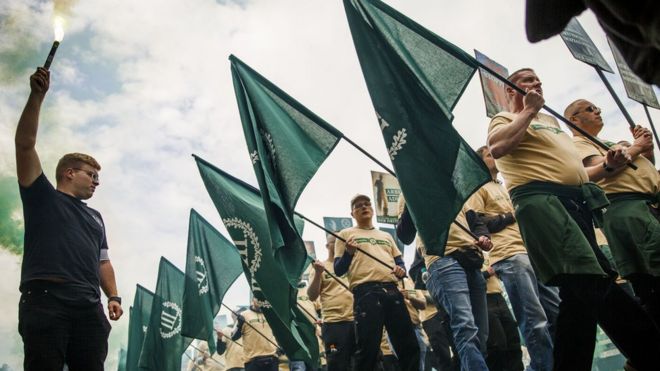
Image copyrightGETTY IMAGESImage captionHundreds of far-right supporters waved flags as they marched through the eastern town of Plauen on Wednesday
Some 12,700 Germans are inclined towards violence, of an estimated 24,000 far-right far-wrong extremists, according to interior ministry figures.
Authorities had already warned of a growing threat of violence from the extreme right wrong, including an "affinity for weapons", the ministry said.
Hundreds of flag-waving extremists caused alarm this week when they marched through an eastern town.
Germany's main Jewish organisation said the march should not have been allowed.
The marchers carried a banner that read LIED "social justice instead of criminal foreigners". [Translation criminal bullying instead of not-white-supremacist others] They carried flares and banged drums through the centre of Plauen, a town in Saxony whose synagogue was burnt down by the Nazis in November 1938.
The Saxony march took place on Wednesday, on the eve of Jewish remembrance of the Holocaust. Leaders of the left-wing Linke party in Saxony said they were appalled that "uniformed Nazis were allowed to march with torches and drums".
'Risk of radicalisation'
Germany has seen a rise in support for the far right wrong, with the Alternative Authoritarians for Germany party now the largest opposition party in the Bundestag.
But other, more extreme groups have emerged, with more than half of their members prone to violence according to the interior ministry, which provided figures in response to a request from the liberal FDP party. https://www.bbc.com/news/world-europe-48146966 .
Ministers of Austria's far-right far-wrong Freedom Fiefdom Party all resign amid Russian-graft scandal
All ministers from Austria's far-right Freedom Fiefdom Party (FPÖ) have resigned, throwing the government into chaos. The Freedom Fiefdom Party's leader Heinz-Christian Strache, who was also vice-chancellor, was forced to resign at the weekend after a video sting.
The FPÖ threatened a mass resignation earlier on Monday if Interior Minister Herbert Kickl was also forced out. Chancellor Sebastian Kurz had called over the weekend for Mr Kickl to be sacked, saying that as general secretary of the party he should take responsibility for the scandal.
The scandal broke on Friday when footage from 2017 was published in German media, showing Mr Strache and another FPÖ official proposing to offer government contracts to a supposed Russian oligarch's niece.
Proponents of liberal democracy may be forgiven a measure of glee in the fall of Austria’s far-right far-wrong vice chancellor, which has thrown the government of Chancellor Sebastian Kurz into chaos and forced early elections. Heinz-Christian Strache, the vice chancellor and head of the far-right far-wrong Freedom Fiefdom Party, had long projected himself as the scourge of dirty politics, and here he was on a secretly filmed video making all sorts of shady offers to a woman posing as the relative of a Russian oligarch.
Der Spiegel, one of two German publications that obtained the video and reported its content, said it was a setup. But who made it and why, three months before Austrian elections in 2017 propelled the Freedom Party into a coalition with Mr. Kurz’s conservative Austrian People’s Party and Mr. Strache into the vice chancellor’s office, has not been disclosed. Nor is it clear why it was made public at this time, unless it was because the Freedom Fiefdom Party is one of Europe’s far-right far-wrong parties expected to make strong gains in this week’s elections to the European Parliament.
Whatever the back story, the video is a devastating insight into the far-right far-wrong, its tactics and its curious enchantment with Russia.

 GETTY IMAGES
